
 Business License

Buried Galvanized Tanks vs Concrete Cisterns
A school in a coastal district replaced a leaking concrete cistern with a bolted galvanized tank, and the water stopped tasting of lime within a week. The concrete had not failed structurally. It had gone porous along a cold joint that nobody had keyed before the second pour.
Both products store water underground, and both are common in the same markets. The choice between them turns on soil chemistry, water table and available site labour far more than on tank volume.
The article below runs a galvanized versus concrete cistern assessment from the excavation up, then sets the buried storage comparison on a life cycle basis. Each cistern construction option is described by what it actually demands of the site rather than by what it costs at the quotation stage.
1. Galvanized Versus Concrete Cistern: The Short Answer
No single answer fits every site, and any buyer who is offered one should ask what it is based on. The galvanized versus concrete cistern choice usually resolves to concrete where labour is cheap, the soil is neutral and the programme is long, and to galvanized where the ground is wet, the programme is short or the soil carries sulphates.
Three questions decide it in practice. What is the soil chemistry, how high does the water table rise, and does the tank have to be working this quarter or next year.
A fourth question sits behind those three. Who is doing the earthworks, and do they have a record of compacting backfill in layers rather than pushing it in with a bucket.
2. Buried Storage Comparison: Shell and Waterproofing
Concrete is monolithic when it is poured in one operation and jointed when it is not. Every joint is a potential leak path, and a buried tank leaks inward as readily as outward once the water table rises above the floor.
Waterproofing on a concrete cistern is either integral, through an additive in the mix, or applied as a membrane on the outside face. Integral waterproofing holds up better because backfill cannot tear it, while a membrane is easier to inspect before the spoil goes back.
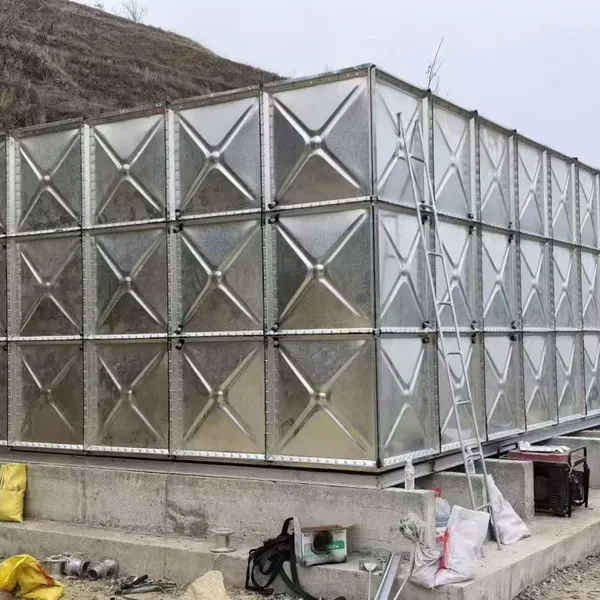
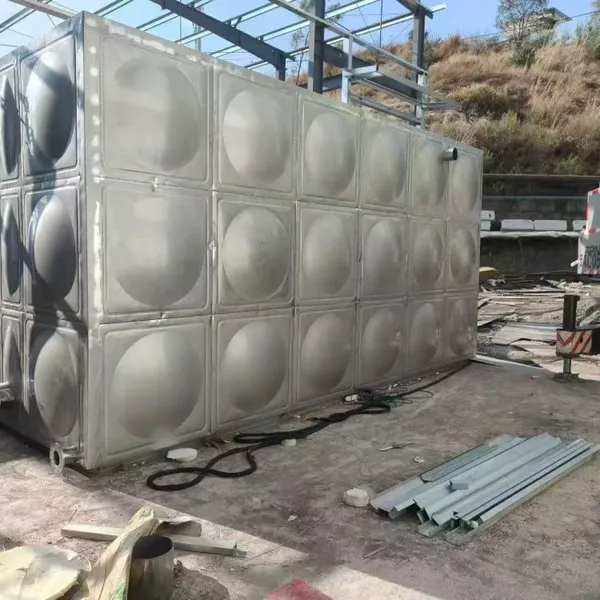
A galvanized tank is a shell of bolted panels with a gasket at every seam, so its leak paths are known, countable and accessible before backfill. That is a different risk profile rather than a safer one, because a gasket that is under-torqued fails quietly.
Any buried storage comparison should therefore compare joint counts rather than materials. A 30 cubic metre concrete cistern may carry four pours and twelve joints, while a galvanized tank of the same volume carries forty seams and no curing time.
3. Cistern Construction Option: Site Conditions That Decide
Every cistern construction option depends on what the excavation reveals. Rock near the surface rules out a deep pour, and running sand rules out an open cut without dewatering.
The water table is the harder constraint. A tank sitting below it must resist uplift while empty, and buoyancy on an empty 20 cubic metre tank reaches 20 tonnes.
Concrete resists uplift through mass. A galvanized tank resists it by anchoring to a base slab, which makes the slab design part of the tank design rather than a separate civil item.
Soil chemistry decides the coating. Sulphates above roughly 0.5 percent in the soil attack zinc, and chlorides above 0.1 percent do the same faster. A site investigation that reports both figures costs little against the cost of a tank that perforates in eight years.
4. Galvanized Versus Concrete Cistern: Cost Structure
Cost comparison between the two is usually done badly, because concrete is quoted as material and galvanized is quoted as a finished product. The galvanized versus concrete cistern figure that matters includes everything the site has to do.
Concrete costs land in five places: excavation, formwork, reinforcement, pour and cure, then waterproofing. The middle three appear on the concrete supplier invoice, and the rest arrive from other trades.
Galvanized costs land in three: panels, coating and erection. Backfill and base slab sit outside both quotes and are often the largest single item on a buried job.
| Cost line | Concrete cistern | Galvanized tank |
|---|---|---|
| Excavation | Large, open cut | Large, open cut |
| Formwork | Significant, reusable partly | None |
| Reinforcement | Significant | Base slab |
| Curing time | 2 to 4 weeks | None |
| Waterproofing | Integral or membrane | Factory coating plus seam coat |
| Site labour | High, skilled trades | Low, bolted assembly |
| Backfill | Layered and compacted | Layered and compacted |
A buried storage comparison that stops at the tank price favours concrete by a wide margin and reverses once formwork and curing time are counted. On a site where the programme is the constraint, the reversal is larger than the material difference.
5. Buried Storage Comparison: Installation Sequence
Concrete takes a sequence measured in weeks: excavate, blind, reinforce, pour base, cure, erect walls, cure, waterproof, backfill. Curing between pours is not optional, and a base poured on Monday cannot carry a wall on Wednesday.
A galvanized tank takes a sequence measured in days: excavate, prepare base, place panels, torque, test, coat seams, backfill. Water testing happens before backfill, which is the point where a defect is still cheap to fix.
Backfill is where most buried tanks fail, whatever the material. Layers over 300 mm compacted with a plate against the tank wall will deflect a panel, and a panel that deflects loses gasket compression at the seam above it.
Both products need the same backfill discipline, so the buried storage comparison often turns on which contractor is handling earthworks rather than on which tank was bought. Sand surround over excavated spoil is the least expensive specification line on the job.
6. Cistern Construction Option: Coating and Protection
Hot-dip galvanizing protects steel twice, by barrier and by sacrifice. In neutral soil that zinc layer lasts decades, and in aggressive soil it does not.
Three defences extend the life of a buried galvanized tank. A bitumen or epoxy coating over the zinc adds a barrier, graded sand backfill removes contact with aggressive spoil, and a sacrificial anode bed wired to the shell keeps the coating defects from corroding.
Adding an anode is cheap at build time and close to impossible to retrofit, because the connection has to reach undisturbed soil. That makes it a cistern construction option worth taking on any site with a resistivity reading below 5,000 ohm centimetres.
Coating damage is the real risk rather than coating quality. A coated panel scratched through at a lifting point becomes a small anode surrounded by a large cathode, and it corrodes faster there than bare galvanized steel would have.
7. Galvanized Versus Concrete Cistern: Water Quality
Concrete raises pH during its first months in service, and new concrete can push stored water above pH 9. A period of fill and discard settles it, and after that a concrete cistern is chemically neutral.
Galvanized steel introduces zinc at low concentration. That level suits irrigation and fire reserve, and it does not suit potable supply without an approved internal lining.
A galvanized versus concrete cistern comparison for drinking water therefore usually ends in a lined galvanized tank or a coated concrete one. Either way the water contact surface becomes a decision of its own, separate from the structure that holds the soil back.
Junping Environmental Protection Equipment asks what the stored water is for before quoting a buried tank, because the answer changes the internal coating rather than the panel schedule. A tank holding fire reserve and a tank holding drinking water can share every panel and every seam, and they cannot share the inner surface.
Zaoqiang Junping Environmental Protection Equipment LLC writes the intended use onto the panel schedule itself, so the coating decision travels with the order rather than with the email that mentioned it.
8. Buried Storage Comparison: Structural Load and Traffic
Both products carry soil load and, where the tank sits under a driveway, vehicle load. That is where the two designs separate.
A concrete cistern with a cast lid spanning 2,000 mm carries a car when the reinforcement is designed for it. A galvanized tank needs a separate cover slab, because a panel roof carries a person and not a vehicle.
Junping supplies a roof load table with every buried tank and states the cover slab thickness required for each traffic class. A buyer who fits a car rated slab over a tank designed for foot traffic has built something that will fail on the first delivery van.
That table is also where a buried storage comparison gets practical. The cost of a traffic rated cover slab is often larger than the difference between the two tank types.
Junping Environmental Protection Equipment reviews the slab against the tank footprint before the excavation is signed off, because a slab that bears on the middle of a panel roof loads the worst possible point. Cover slab design follows the same logic as the tank itself. A slab spanning 2,000 mm under a car needs a depth and a reinforcement schedule that a foot traffic lid does not, and the tank roof beneath it needs support at the slab edges rather than in the middle.
9. Cistern Construction Option: Repair and Service Life
Concrete repair means breaking out and re-pouring, which is a major intervention on a buried structure. Galvanized repair means replacing a panel, which is a day of work where the tank has a hatch large enough to pass it.
Service life depends more on soil and water than on material. A concrete cistern in neutral ground behind a sound membrane runs 50 years. A galvanized tank in the same conditions runs 25 to 40 years on zinc alone and longer with a coating and an anode.
That makes the cistern construction option a question of how the tank will be inspected rather than of how it will be built. A tank with no access for inspection reaches the end of its life without anyone noticing.
Run the buried storage comparison on life cycle cost and on the assumption of one inspection every five years. A first cost comparison that assumes no inspection is a comparison between two products that will both surprise their owners.
10. FAQ: Buried Storage and Concrete Cistern Questions
10.1 Which is cheaper, a galvanized tank or a concrete cistern?
Concrete is usually cheaper in material and more expensive in labour, and the balance swings with local wage rates. On a site with cheap formwork labour and a long programme, a concrete cistern wins. On a site with expensive labour, a high water table or a short programme, a bolted galvanized tank wins. Compare total installed cost rather than tank cost, including excavation, base, backfill and curing time on both sides, since most comparisons that surprise a buyer have left curing time out of the concrete column.
10.2 How long does a buried galvanized water tank last?
Between 25 and 40 years in neutral soil with a sound zinc coating, and considerably less in sulphate bearing ground or where the water table fluctuates. A dielectric coating, sand backfill and a sacrificial anode extend that range at modest cost. The variables that shorten it are coating damage during handling, backfill of aggressive excavated spoil and stray current from nearby power infrastructure, and an inspection every five years catches coating breakdown while the steel behind it is still sound and still worth protecting.
10.3 Can a galvanized tank hold drinking water underground?
Not in bare galvanized form, because zinc reaches the water at a concentration most potable standards do not accept. An approved internal lining or a food grade coating resolves it, and the tank then performs the same duty as a lined concrete cistern. State the potable requirement in the enquiry rather than after delivery, because the internal coating is applied in the factory and cannot be added on site. Fire reserve and irrigation have no such requirement and can use the bare shell.
10.4 What is the main cause of failure in a buried tank?
Backfill, in most cases, rather than the tank itself. Spoil dropped in thick layers, or compacted with a plate running against the wall, deflects a panel or cracks a wall before the tank is even filled. The second cause is uplift on an empty tank in a high water table, which lifts a shell off its base and opens every seam at once. Both are construction errors rather than material failures, which is why the earthworks contractor matters as much as the tank supplier.
Recently Posted
-
Car Wash Grating Layout: Slope, Pit Depth and Flow
November 3, 2026A three bay site opened with new grating over the old pit, and by the second weekend water stood 40 mm deep at the entrance to bay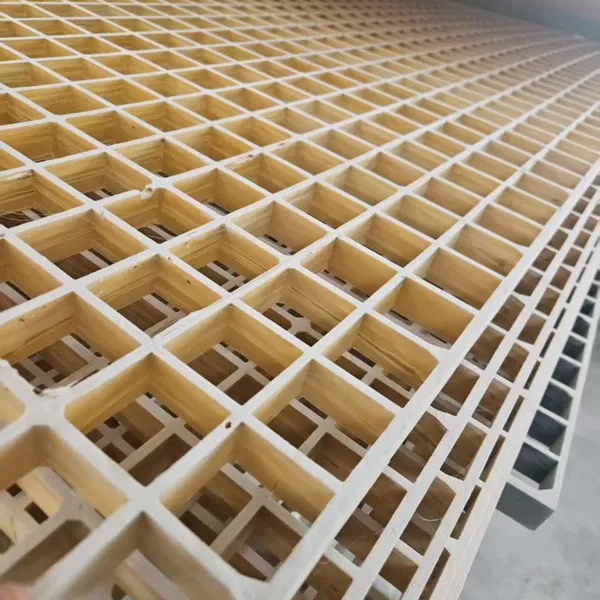 Read More
-
SMC Water Tank Panel Thickness and Pressure Ratings
November 3, 2026A contractor in East Africa specified a 4 metre high panel tank on one 8 mm wall schedule from top to bottom, because the drawing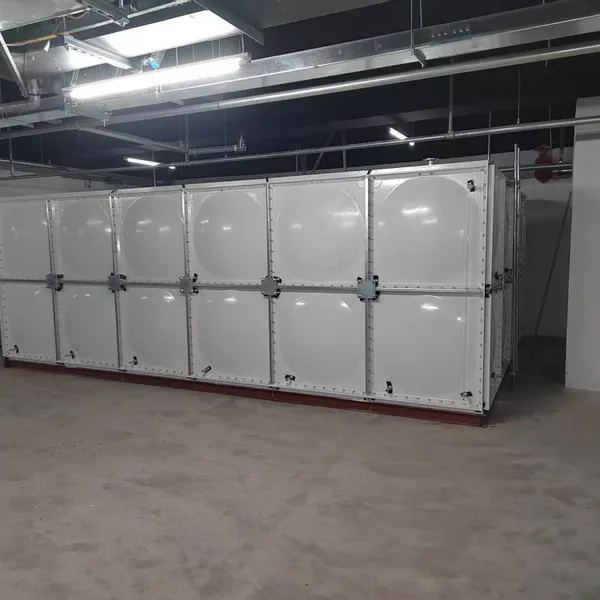 Read More
-
Sourcing FRP Grating: MOQ, Lead Time and Inspection Points
November 3, 2026A buyer in Southeast Asia ordered 120 square meters of molded grating and asked for a delivery date in three weeks. The supplier c Read More
-
What Is an FRP Domestic Water Tank? Household and Building Use
November 2, 2026A family in a hill town outside a municipal supply zone installed a 1,000 litre plastic tank on the roof. Two summers later the ta Read More

Contact Us
Recommended Products
-
 Desalination Plant FRP Grating Seawater Resistant Corrosion Proof Walkway PanelNegotiableMOQ: 300 Square Meters
-
Light High Strength Fiberglass Grating Coastal Dock WalkwayNegotiableMOQ: 100 Square Meters
-
Offshore Platform FRP Grating Saltwater Corrosion Resistant Oil Gas Deck FlooringNegotiableMOQ: 300 Square Meters
-
Fiberglass Reinforced Plastic FRP Grating for Industrial PlatformNegotiableMOQ: 100 Square Meters
-
Anti‑corrosion FRP Grating Production Proces 50mm FRP Grating PlateNegotiableMOQ: 300 Square Meters
-
Professional SMC FRP Composite Bolted Panel Water Tank for Residential Rooftop TankNegotiableMOQ: 1 Cubic Meter
-
Easy Install SMC FRP Composite Bolted Panel Water Tank for Villa Rooftop Water StorageNegotiableMOQ: 1 Cubic Meter
-
High Quality SMC FRP Composite Bolted Panel Water Tank for Remote Area Water SupplyNegotiableMOQ: 1 Cubic Meter
-
Professional SMC FRP Composite Bolted Panel Water Tank for Rooftop Water StorageNegotiableMOQ: 1 Cubic Meter
-
Bulk Supply SMC FRP Composite Modular Panel Water Tank for Villa Rooftop Water StorageNegotiableMOQ: 1 Cubic Meter
-
Premium SMC FRP Composite Modular Panel Water Tank for Coastal Area Water TankNegotiableMOQ: 1 Cubic Meter
-
Cost Effective SMC FRP Composite Sectional Water Tank for Temporary Camp Water SupplyNegotiableMOQ: 1 Cubic Meter
-
Easy Install SMC FRP Composite Sectional Water Tank for Temporary Camp Water SupplyNegotiableMOQ: 1 Cubic Meter
-
Industrial Grade SMC FRP Composite Bolted Panel Water Tank for Rainwater Harvesting StorageNegotiableMOQ: 1 Cubic Meter
-
Bulk Supply SMC FRP Composite Modular Panel Water Tank for Coastal Area Water TankNegotiableMOQ: 1 Cubic Meter
-
Export Grade SMC FRP Composite Modular Panel Water Tank for Fishing Village Water StorageNegotiableMOQ: 1 Cubic Meter
-
New Design Porcelain Enamel Steel Bolted Panel Water Tank for Swimming Pool Heating Water StorageNegotiableMOQ: 1 Cubic Meter
-
Premium Porcelain Enamel Steel Bolted Panel Water Tank for Textile Plant Hot Water StorageNegotiableMOQ: 1 Cubic Meter
-
Heavy Duty Porcelain Enamel Steel Sectional Water Tank for Dairy Processing Hot WaterNegotiableMOQ: 1 Cubic Meter
-
Easy Install Porcelain Enamel Steel Bolted Panel Water Tank for Hot Water StorageNegotiableMOQ: 1 Cubic Meter