
 Business License

SMC Water Tank Panel Thickness and Pressure Ratings
A contractor in East Africa specified a 4 metre high panel tank on one 8 mm wall schedule from top to bottom, because the drawing carried a single thickness note. The base course bowed outward within the first fill and the gaskets at the bottom seam began to weep.
The tank had not been built badly. It had been specified as though water pressure were the same at every depth.
Water pressure rises linearly with depth, and panel thickness has to follow it. This article sets out the SMC panel thickness pressure relationship, explains what a water tank panel rating actually certifies, and shows how FRP tank wall thickness is set course by course.
1. SMC Panel Thickness Pressure Relationship Explained
Hydrostatic pressure depends on depth alone, not on tank volume. A 10 cubic metre tank 5 metres high sees more pressure at its base than a 100 cubic metre tank 2 metres high.
The arithmetic is simple. Pressure in kilopascals equals roughly 9.8 times the head in metres, so a 2 metre head gives about 20 kPa and a 4 metre head about 39 kPa.
That pressure acts on the panel as a distributed load, and the panel responds by deflecting inward. The SMC panel thickness pressure relationship is therefore a deflection problem rather than a strength problem, because a panel almost never ruptures before it bends too far.
Deflection is what breaks the seal. A panel that bows by 10 mm at the centre pulls its edges away from the gasket line, and the joint opens even though no material has failed.
The distinction matters when a buyer compares quotations. Two suppliers can offer the same nominal thickness and produce tanks with very different behaviour, because the tie rod grid behind the panel is doing as much work as the laminate in front of it.
2. Water Tank Panel Rating: What the Number Means
A water tank panel rating is a statement about a panel at a stated support condition, and it is meaningless without that condition attached.
Molded panels are supported on four edges by the adjacent panels and by the frame, and the span between supports is the diagonal of the square they enclose. A 1,000 mm panel with a mid-panel tie rod behaves very differently from the same panel without one.
Ratings are usually published as a maximum head per thickness at a given panel size, with the deflection limit stated alongside. A figure quoted without the deflection limit and the panel size cannot be checked.
Junping Environmental Protection Equipment publishes the water tank panel rating as a table of thickness against head for each panel size in its range, with the deflection limit as a separate column rather than a footnote.
3. FRP Tank Wall Thickness by Course and Head
FRP tank wall thickness is set course by course, because pressure falls as the water rises. A tank 4 metres high is usually built from three thicknesses, not one.
The bottom course carries the full 4 metre head, the second course carries 3 metres, and so on. Working upward, each course can step down by one or two millimetres.
| Course (from base) | Head at course base | Indicative thickness | Note |
|---|---|---|---|
| Course 1 | 4.0 m | 12 to 14 mm | Full head, tie rods at mid height |
| Course 2 | 3.0 m | 10 to 12 mm | Tie rods at this level |
| Course 3 | 2.0 m | 8 to 10 mm | Common step point |
| Course 4 | 1.0 m | 6 to 8 mm | Roof bearing course |
Those figures assume a 1,000 mm panel with a tie rod grid at about 1,000 mm spacing. Widen the tie grid and every thickness in the table rises.
Junping builds the schedule from the head at each course rather than from total height, so a tank on a plinth does not get a heavier bottom course than the water actually requires.
4. SMC Panel Thickness Pressure Test: The Hydrostatic Check
Every tank is proved by a hydrostatic test rather than by a calculation, and the SMC panel thickness pressure check is where a specification error shows up.
The test fills the tank in stages, holding at each stage long enough to inspect every seam. Three stages at one third, two thirds and full are the usual sequence.
Deflection is measured at the centre of the bottom course panels during the full stage. A reading above the design limit means the bottom course is too thin or the tie grid is too wide, and neither can be fixed after the tank is on its plinth.
The test also reveals gasket compression problems that a dry assembly hides. A seam that weeps at two thirds and seals at full is a seam with an uneven torque pattern rather than a thickness fault.
5. Water Tank Panel Rating: Panel Size and Tie Rod Effect
Panel size changes a water tank panel rating more than most buyers expect, because the unsupported span is the controlling dimension rather than the panel area.
A 1,000 by 1,000 mm panel spans 1,414 mm across its diagonal when the edges carry the support and nothing crosses the face. Adding a tie rod through the centre cuts that span roughly in half and reduces deflection by a factor near sixteen.
Zaoqiang Junping Environmental Protection Equipment LLC sets the tie grid on a 1,000 mm module as standard and closes it to 500 mm on the bottom two courses of any tank above 3 metres.
That is why a tank with a dense tie rod grid can use thinner panels than one relying on edge support alone. The tie rods are doing structural work, not just holding the walls together.
The trade is maintenance. Tie rods sit inside the tank, collect scale and need inspection, and a tank owner who removes them to improve flow has removed the reason the panels are thin.
6. FRP Tank Wall Thickness Against Temperature and Chemical Load
FRP tank wall thickness is set by mechanical load first, and then adjusted for temperature and chemistry, because both reduce the resin system's stiffness.
Water at 60 C reduces the modulus of an isophthalic laminate by roughly a quarter against its value at 20 C. A tank at that temperature needs one thickness step above the cold water schedule, or a resin with a higher heat distortion point.
Chemistry acts differently. Chlorine and dilute acids attack the surface rather than the section, so they call for a resin change and a thicker inner gelcoat rather than a thicker panel.
The two effects do not simply add. A hot chlorinated duty usually resolves to vinyl ester at the mechanical thickness, and the wall does not grow further.
Density belongs in the same discussion, since a brine tank at 1,200 kg per cubic metre develops 20 percent more pressure at the same depth than a fresh water tank does. That is enough to change a course thickness on a tank above 3 metres.
7. SMC Panel Thickness Pressure: Frame and Tie Rod Interaction
Panels carry load as a system with the frame, and the SMC panel thickness pressure figure assumes the frame is doing its share.
An external frame of galvanized or stainless angle resists the outward thrust at the panel joints. An internal tie rod grid resists it across the panel face. Most tanks use both.
An external frame also carries the roof load into the walls, which is why frame section and panel thickness are usually chosen together rather than in sequence.
Where a tank sits inside a concrete pit, the pit wall can take the thrust instead, and the frame becomes a spacer. That arrangement allows a lighter panel and it removes the ability to inspect the wall from outside.
Junping Environmental Protection Equipment states which thrust path the design assumes on the general arrangement drawing, because a tank designed for a pit and then installed freestanding has no frame to take the load.
8. Water Tank Panel Rating: Writing It into a Specification
A water tank panel rating belongs in a specification as four linked numbers rather than as one thickness. Thickness alone tells a fabricator nothing about whether the design is sound.
The four are panel thickness, panel size, tie rod spacing and design head. Add the deflection limit and the specification can be checked by anyone holding a tape measure and a straight edge.
A specification that names a thickness and nothing else invites a supplier to meet it with a wide tie grid and a thin frame, which passes the thickness clause and fails the intent.
The better clause reads as a performance requirement: no panel deflection above 10 mm at design head, with the thickness and tie grid left to the supplier to propose. That wording transfers the calculation to the party responsible for it.
9. FRP Tank Wall Thickness Inspection and Tolerance
Inspecting FRP tank wall thickness on delivery is a matter of a calibrated gauge and a marked grid, and it takes less than an hour on a mid-sized tank.
Measure at the centre and at four points near the edges of one panel per course, on at least two adjacent walls. Molded thickness tolerance is typically plus or minus 1 mm, and a panel below nominal minus 1 mm should be rejected rather than accepted with a note.
Check the panel mark against the schedule as well. A bottom course panel and a top course panel look similar on a stack, and a mixed stack is a common source of a thin panel at the base.
Junping Environmental Protection Equipment stamps the course number on the panel edge and repeats it on the packing list, so a site check compares a physical mark against a document rather than against memory.
10. FAQ: SMC Water Tank Panel Thickness Questions
10.1 How is SMC panel thickness pressure calculated?
Pressure at any depth equals about 9.8 kilopascals per metre of head, so a 3 metre tank sees roughly 29 kPa at its base. That pressure is applied as a distributed load to each panel, and the design check is deflection at the panel centre rather than stress at the edge. A common limit is 10 mm or one two-hundredth of the span, whichever is smaller. Thickness then follows from the panel size and the tie rod spacing, which is why the same head can require two different thicknesses on two different layouts.
10.2 Why does the bottom course need a thicker panel?
Because pressure is proportional to depth and the base carries the full head. In a 4 metre tank the bottom course sees about 39 kPa while the top course sees under 10 kPa. Building every course to the base requirement wastes material and money, while building every course to the top requirement produces a tank that bows and leaks. Stepping thickness upward as head falls is the standard approach, and it usually means three thicknesses in a tank of that height rather than one.
10.3 Does a thicker panel always solve a leaking tank?
No, and this is where buyers waste money. A leak at a seam is usually a gasket or torque problem rather than a panel stiffness problem, and a thicker panel with the same uneven tightening will still leak. Deflection driven seepage shows up as a bow at mid panel, which a straight edge will confirm in seconds. Check deflection first, then torque, then gasket condition, since replacing panels to fix a torque fault doubles the cost and leaves the cause in place.
10.4 What tolerance applies to FRP tank wall thickness?
Molded SMC panels typically hold plus or minus 1 mm against nominal, which is tight enough for a tank schedule built in 2 mm steps. Hand layup cannot hold that and is normally quoted at plus or minus 1.5 mm or worse. Measure with a calibrated gauge at the panel centre and near the edges, since a panel can be on nominal in the middle and thin at the flange. Reject anything below nominal minus 1 mm rather than accepting it with a note, because the base course has no margin to give away.
Recently Posted
-
Car Wash Grating Layout: Slope, Pit Depth and Flow
November 3, 2026A three bay site opened with new grating over the old pit, and by the second weekend water stood 40 mm deep at the entrance to bay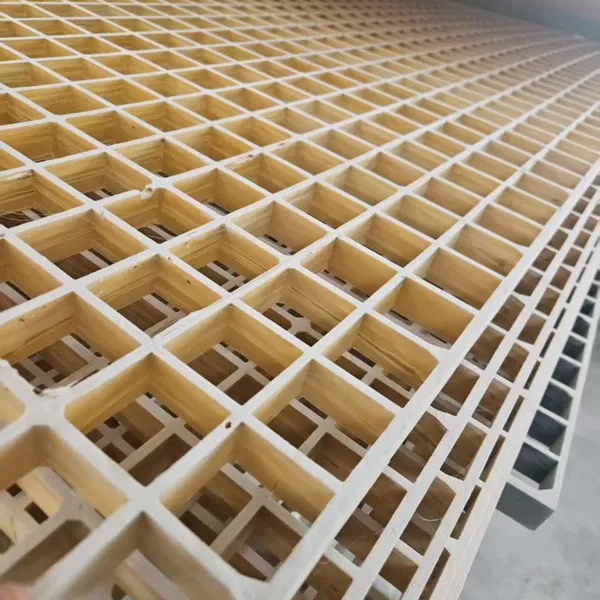 Read More
-
Sourcing FRP Grating: MOQ, Lead Time and Inspection Points
November 3, 2026A buyer in Southeast Asia ordered 120 square meters of molded grating and asked for a delivery date in three weeks. The supplier c Read More
-
Buried Galvanized Tanks vs Concrete Cisterns
November 2, 2026A school in a coastal district replaced a leaking concrete cistern with a bolted galvanized tank, and the water stopped tasting of Read More
-
What Is an FRP Domestic Water Tank? Household and Building Use
November 2, 2026A family in a hill town outside a municipal supply zone installed a 1,000 litre plastic tank on the roof. Two summers later the ta Read More

Contact Us
Recommended Products
-
 Desalination Plant FRP Grating Seawater Resistant Corrosion Proof Walkway PanelNegotiableMOQ: 300 Square Meters
-
Light High Strength Fiberglass Grating Coastal Dock WalkwayNegotiableMOQ: 100 Square Meters
-
Offshore Platform FRP Grating Saltwater Corrosion Resistant Oil Gas Deck FlooringNegotiableMOQ: 300 Square Meters
-
Fiberglass Reinforced Plastic FRP Grating for Industrial PlatformNegotiableMOQ: 100 Square Meters
-
Anti‑corrosion FRP Grating Production Proces 50mm FRP Grating PlateNegotiableMOQ: 300 Square Meters
-
Professional SMC FRP Composite Bolted Panel Water Tank for Residential Rooftop TankNegotiableMOQ: 1 Cubic Meter
-
Easy Install SMC FRP Composite Bolted Panel Water Tank for Villa Rooftop Water StorageNegotiableMOQ: 1 Cubic Meter
-
High Quality SMC FRP Composite Bolted Panel Water Tank for Remote Area Water SupplyNegotiableMOQ: 1 Cubic Meter
-
Professional SMC FRP Composite Bolted Panel Water Tank for Rooftop Water StorageNegotiableMOQ: 1 Cubic Meter
-
Bulk Supply SMC FRP Composite Modular Panel Water Tank for Villa Rooftop Water StorageNegotiableMOQ: 1 Cubic Meter

-
Premium SMC FRP Composite Modular Panel Water Tank for Coastal Area Water TankNegotiableMOQ: 1 Cubic Meter
-
Cost Effective SMC FRP Composite Sectional Water Tank for Temporary Camp Water SupplyNegotiableMOQ: 1 Cubic Meter
-
Easy Install SMC FRP Composite Sectional Water Tank for Temporary Camp Water SupplyNegotiableMOQ: 1 Cubic Meter
-
Industrial Grade SMC FRP Composite Bolted Panel Water Tank for Rainwater Harvesting StorageNegotiableMOQ: 1 Cubic Meter
-
Bulk Supply SMC FRP Composite Modular Panel Water Tank for Coastal Area Water TankNegotiableMOQ: 1 Cubic Meter

-
Export Grade SMC FRP Composite Modular Panel Water Tank for Fishing Village Water StorageNegotiableMOQ: 1 Cubic Meter
-
New Design Porcelain Enamel Steel Bolted Panel Water Tank for Swimming Pool Heating Water StorageNegotiableMOQ: 1 Cubic Meter
-
Premium Porcelain Enamel Steel Bolted Panel Water Tank for Textile Plant Hot Water StorageNegotiableMOQ: 1 Cubic Meter
-
Heavy Duty Porcelain Enamel Steel Sectional Water Tank for Dairy Processing Hot WaterNegotiableMOQ: 1 Cubic Meter
-
Easy Install Porcelain Enamel Steel Bolted Panel Water Tank for Hot Water StorageNegotiableMOQ: 1 Cubic Meter