
 Business License
Blog Categories

FRP Grating Load Rating: Mesh Size, Thickness and Span Tables
A maintenance engineer compared two quotations on a printed load table, chose the panel with the higher figure, and installed it across supports 400 mm wider than the table assumed. The walkway felt firm underfoot and sagged visibly under a pallet truck.
Nothing in the table was wrong. The table simply belonged to a span the project did not have.
An FRP grating load rating table is a set of numbers indexed by support spacing, and reading it correctly is the whole skill. This article explains how the table is built, where a 38mm FRP grating panel sits within it, and how the FRP grating maximum span is limited by deflection before strength.
1. FRP Grating Load Rating Table: How to Read One
An FRP grating load rating table is organised as a grid: panel depth down one side, support span across the top, and a load figure in each cell.
Three things must be stated alongside those cells for the table to be usable: the deflection limit, the load type, and whether the figure is a working load or a failure load.
Most tables assume a deflection limit of span over 200 or 10 mm, whichever is smaller. That limit, not the failure load, usually governs the number in the cell.
A table without those three statements is a table of unlabelled numbers. Ask for the assumptions page, not just the grid.
Watch for a fourth assumption as well: the support condition. A cell computed for a panel fixed at all four edges and clipped at every intersection describes a stiffer structure than a panel that is simply laid on two stringers.
2. 38mm FRP Grating Panel: Where It Fits
A 38mm FRP grating panel sits in the middle of the molded range, above 25 mm and 30 mm panels and below 50 mm.
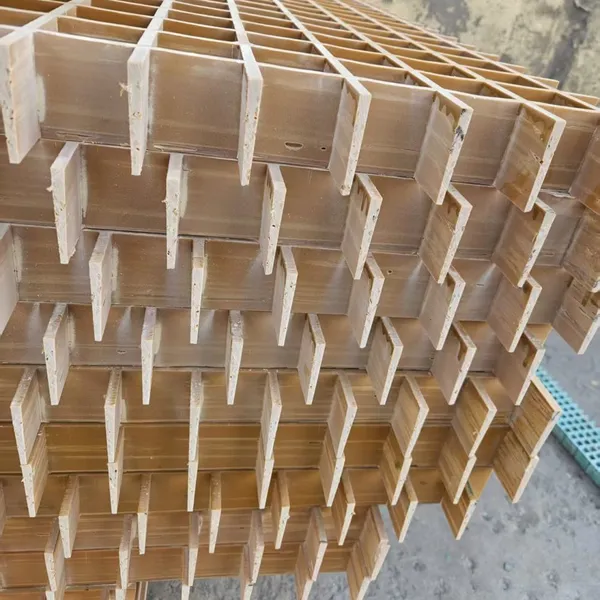
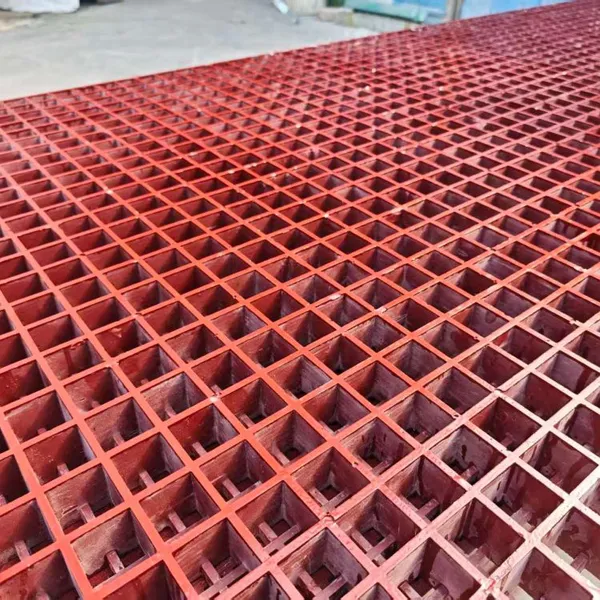
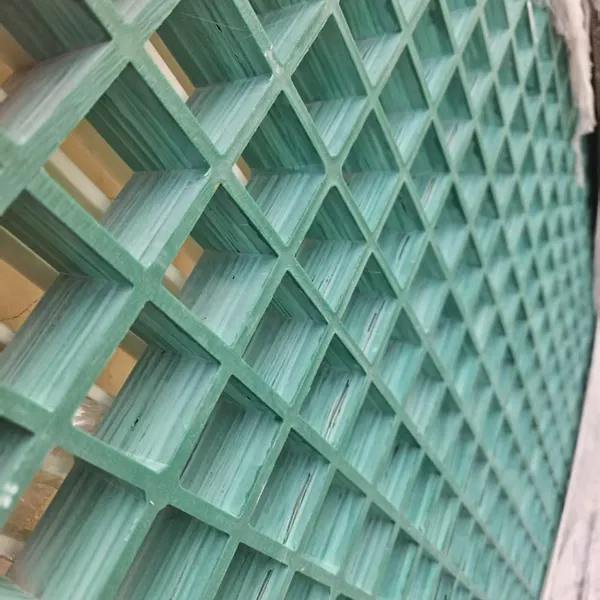
Its mesh is usually 38 mm square, which gives roughly 70 percent open area and a bar depth of 38 mm. That depth is what carries the load, and the mesh is what passes water and debris.
A 38mm FRP grating panel spans about 1,200 mm between supports under a 5 kN per square meter uniform load with deflection inside span over 200. Tighten the supports to 900 mm and the same panel takes roughly double.
| Panel depth | Span 600 mm | Span 900 mm | Span 1,200 mm | Span 1,500 mm |
|---|---|---|---|---|
| 25 mm | 12 kN/m2 | 6.5 kN/m2 | 3.5 kN/m2 | Not advised |
| 30 mm | 16 kN/m2 | 8.5 kN/m2 | 4.5 kN/m2 | 2.5 kN/m2 |
| 38 mm | 28 kN/m2 | 14 kN/m2 | 7.5 kN/m2 | 4.5 kN/m2 |
| 50 mm | 45 kN/m2 | 24 kN/m2 | 13 kN/m2 | 8 kN/m2 |
Those figures are indicative and assume a uniform load with a span over 200 deflection limit. A concentrated load case produces lower numbers in every cell.
3. FRP Grating Maximum Span: The Deflection Limit
The FRP grating maximum span is set by deflection in almost every practical case, because a molded panel bends long before it breaks.
Deflection rises with the fourth power of span. Doubling the span multiplies deflection by sixteen, so a panel that deflects 4 mm at 900 mm deflects 64 mm at 1,800 mm under the same load.
That is why span tables look so steep. The numbers fall away quickly, and the difference between 900 mm and 1,200 mm supports is larger than most buyers expect.
A deflection limit exists for two reasons: it keeps the walkway feeling solid, and it keeps the panel edges from rotating far enough to open a joint.
Structural engineers often apply a tighter limit on a visible walkway than the table does, at span over 300, because a floor that bounces reads as unsafe even when it is sound.
4. FRP Grating Load Rating Table: Uniform and Concentrated
Two load types appear in any FRP grating load rating table, and they rarely give the same answer for the same panel.
A uniform load spreads across the whole panel, which suits a panel supported on four edges with a stiff cross bar. A concentrated load sits on a small area, such as a wheel, a foot or a pallet corner.
A 38 mm panel at 1,200 mm span may carry 7.5 kN per square meter uniformly and still deflect beyond limit under a single 3 kN wheel at mid span.
Junping prints both columns on the same sheet rather than on facing pages, because a buyer reading one page has no reason to turn it. The same sheet also carries the deflection limit and the support condition, so no cell can be read without them.
Check both columns for any walkway that carries vehicles or trolleys. Foot traffic alone can be checked on the uniform figure with a separate point load check at mid span.
5. 38mm FRP Grating Panel: Weight, Handling and Support Load
The 38mm FRP grating panel weighs about 19 to 22 kg per square meter depending on resin and grit, which is light enough for two people to handle a standard panel.
That weight matters twice. It reduces the load on the supporting steel, and it sets how large a loose access panel can be before it needs lifting equipment.
A 1,220 by 3,660 mm panel at that weight comes to roughly 85 to 98 kg. Two people can carry it flat on edge over short distances and cannot lift it safely onto a high frame.
Grit top adds about 1 kg per square meter against a plain top, which is small against the panel itself and enough to matter when a delivery arrives without lifting gear on site.
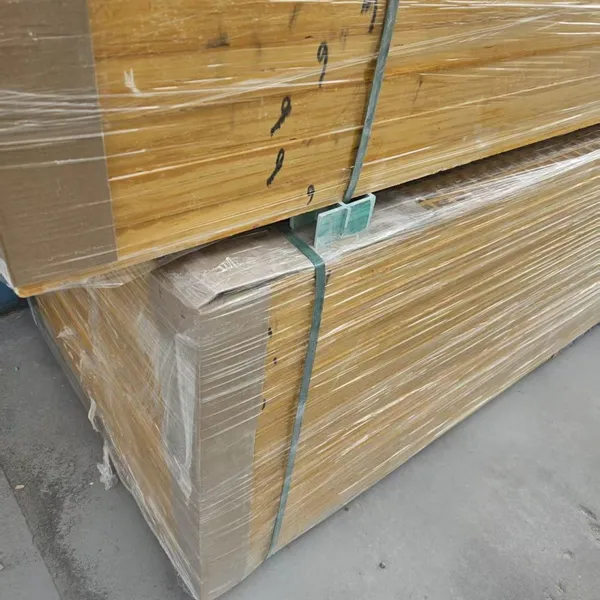
Junping Environmental Protection Equipment labels each bundle with its weight and centre of gravity, because a bundle that is light enough for a crane but awkward for two people is a handling decision rather than a lifting one.
6. FRP Grating Maximum Span: Support Detail Effects
Real supports are not the ideal line supports a table assumes, and the FRP grating maximum span shortens as the support detail degrades.
A panel bearing 40 mm on a flat flange behaves close to the table. A panel bearing 20 mm on an angle edge behaves worse, because the bar end can rotate and the effective span grows.
Clips that hold the panel down at every intersection restore some of that stiffness. Clips at alternate bars do less, and a panel that is simply laid in place gets no benefit at all.
The practical rule is to add one support line wherever the bearing is under 40 mm or the panel is not clipped. That costs less than the next panel depth up.
Junping asks for the support drawing before releasing a span figure, because the panel depth on the quotation and the support spacing on the steel drawing are often decided by two different people on the same project.
7. FRP Grating Load Rating Table: Temperature and Resin Derating
A load table is published for a resin at room temperature, and an FRP grating load rating table used outside that condition needs derating.
A vinyl ester laminate holds its modulus to about 90 degrees Celsius, while an isophthalic laminate softens from around 60 degrees. Above those points the panel deflects further under the same load.
A walkway over a steam line or beside a furnace therefore needs either a higher temperature resin or a shorter span. The table will not say so.
Chemical exposure acts differently again. A resin attacked by a solvent loses surface first and section later, so a table figure taken from a new panel overstates a panel in service.
Ask for the derating basis when a walkway sits at either extreme. A supplier who publishes a single row of numbers for all conditions has published a room temperature figure and applied it everywhere.
8. 38mm FRP Grating Panel: Against 30 mm and 50 mm
The choice between 30 mm, 38 mm and 50 mm panels comes down to span, load and cost, and the middle option wins more often than either end.
A 30 mm panel suits light foot traffic at spans under 900 mm and costs less. A 50 mm panel suits vehicle traffic and long spans and costs perhaps 40 percent more than 38 mm.
The 38mm FRP grating panel sits where most industrial walkways land: spans near 1,200 mm, occasional trolley traffic, and a budget that will not stretch to the deeper section.
Zaoqiang Junping Environmental Protection Equipment LLC quotes the three depths against the same support layout so the cost of tightening supports can be compared with the cost of a deeper panel. On short runs the deeper panel usually wins, and on long runs the extra steel usually does not.
9. FRP Grating Maximum Span: Cutting and Edge Support
A cut panel loses stiffness at the cut, and the FRP grating maximum span has to account for it.
A panel cut parallel to the bearing bars keeps its full depth and loses nothing but the cross bar at the edge. A panel cut across the bars loses the load path that ties them together.
Where a cut lands mid span, add a support or a trim bar along the cut. A trim bar bonded or bolted to the cut edge restores most of the lost stiffness at a fraction of the cost of a new panel.
Panels cut to fit around a column need a trim bar on every cut edge, not just the one facing the walkway. Water and load both find the unsupported edge.
Order the trim bars with the panels rather than after the cut. A trim bar that arrives three weeks later leaves an open edge exposed for the whole of that period, and an open edge takes water into the glass bundles.
10. FAQ: FRP Grating Load Rating Questions
10.1 How do I read an FRP grating load rating table?
Find your panel depth on one axis and your actual support spacing on the other, then read the cell where they meet. Before using the number, confirm three assumptions: the deflection limit, whether the figure is a working or failure load, and whether it applies to a uniform or a concentrated load. A table that omits those three cannot be checked, and most disputes about a sagging walkway trace back to a number read from the wrong column rather than to a defective panel.
10.2 What is the maximum span for 38mm grating?
About 1,800 mm for foot traffic on a light load, and 1,200 to 1,500 mm for anything carrying trolleys or a 5 kN per square meter duty. Beyond 1,800 mm the deflection limit governs and the panel needs intermediate support rather than a heavier section. A 50 mm panel reaches roughly 2,400 mm on the same basis. The figure moves with support detail as well, so a panel bearing on a narrow angle has to be treated as spanning further than its nominal spacing suggests on the drawing.
10.3 Why does my panel deflect more than the table says?
Four common causes, in order of frequency. The span is measured between bolt centres rather than between bearing faces, the bearing is under 40 mm so the bar end rotates, the panel is unclipped, or the load is concentrated rather than uniform. A fifth cause is temperature, since an isophthalic panel above about 60 degrees Celsius loses stiffness. Measure the actual clear span first, because a 50 mm error at each end is enough to explain a visible sag on its own, and it takes a tape and ten minutes.
10.4 Does a deeper panel always solve a deflection problem?
No, and on long runs it is usually the expensive answer. Deflection falls with the cube of depth but with the fourth power of span, so halving the span gains far more than increasing the depth. Adding one support line in the middle of a 2,400 mm run does more than moving from 38 mm to 50 mm, and it usually costs less in panel and in freight. Compare the two options on total installed cost, including the steel, before choosing a deeper section.
Recently Posted
-
Welded Modular vs Bolted Panel Stainless Tanks
November 5, 2026A bottling plant ordered a bolted panel tank because the panels would fit up a service stair, then filled it and watched a bead of Read More
-
Moving and Erecting Large Tank Sections
November 5, 2026A 500 cubic metre galvanized tank arrived on site as twelve wall sections and a stack of base plates, and the contractor had booke Read More
-
Solid Top Grating in Battery Rooms and Chemical Stores
November 5, 2026A telecom site replaced its open grid battery room floor with the same product after a spill ran straight through and pooled under Read More
-
Buying Car Wash Grating: Load Class and Detergent Resistance
November 4, 2026A chain bought 380 square meters of grating for nine new bays on a single price comparison. Two seasons later the panels at the en Read More

Contact Us
Recommended Products
-
 Desalination Plant FRP Grating Seawater Resistant Corrosion Proof Walkway PanelNegotiableMOQ: 300 Square Meters
-
Light High Strength Fiberglass Grating Coastal Dock WalkwayNegotiableMOQ: 100 Square Meters
-
Offshore Platform FRP Grating Saltwater Corrosion Resistant Oil Gas Deck FlooringNegotiableMOQ: 300 Square Meters
-
Fiberglass Reinforced Plastic FRP Grating for Industrial PlatformNegotiableMOQ: 100 Square Meters
-
Anti‑corrosion FRP Grating Production Proces 50mm FRP Grating PlateNegotiableMOQ: 300 Square Meters

-
Top Quality SMC FRP Composite Modular Panel Water Tank for Island Water SupplyNegotiableMOQ: 1 Cubic Meter
-
Reliable SMC FRP Composite Modular Panel Water Tank for Rooftop Water StorageNegotiableMOQ: 1 Cubic Meter
-
High Performance SMC FRP Composite Modular Panel Water Tank for Residential Rooftop TankNegotiableMOQ: 1 Cubic Meter
-
Reliable SMC FRP Composite Modular Panel Water Tank for Lightweight Water StorageNegotiableMOQ: 1 Cubic Meter
-
Cost Effective SMC FRP Composite Bolted Panel Water Tank for Villa Rooftop Water StorageNegotiableMOQ: 1 Cubic Meter
-
Health Commission FRP Grating Wear Dust Resistant Anti Slip Government Office Floor PanelNegotiableMOQ: 300 Square Meters
-
High Performance SMC FRP Composite Sectional Water Tank for Rainwater Harvesting StorageNegotiableMOQ: 1 Cubic Meter
-
Bulk Supply SMC FRP Composite Bolted Panel Water Tank for Coastal Area Water TankNegotiableMOQ: 1 Cubic Meter
-
Food Street FRP Grating Wear Oil Resistant Anti Slip Outdoor Walkway PanelNegotiableMOQ: 300 Square Meters
-
High Quality SMC FRP Composite Sectional Water Tank for Mountain Resort Water StorageNegotiableMOQ: 1 Cubic Meter
-
Easy Install SMC FRP Composite Modular Panel Water Tank for Coastal Area Water TankNegotiableMOQ: 1 Cubic Meter
-
Resort FRP Grating Wear Moisture Resistant Anti Slip Outdoor Walkway PanelNegotiableMOQ: 300 Square Meters
-
Durable SMC FRP Composite Modular Panel Water Tank for Residential Rooftop TankNegotiableMOQ: 1 Cubic Meter
-
Large Capacity SMC FRP Composite Sectional Water Tank for Villa Rooftop Water StorageNegotiableMOQ: 1 Cubic Meter
-
Scenic Area FRP Grating Wear Weather Resistant Anti Slip Outdoor Walkway PanelNegotiableMOQ: 300 Square Meters